Anatomy of an Interview:
Tomorrow Show, 26th June, 1980
First
published Sam Liston PiL site, 1996
© 1996 Dan Nolte
Fodderstompf: This article is actually a college paper which was submitted to the – long defunct – Stan Liston PiL site. The original Fodderstompf site archived the article in 1999. It has not been altered in any way.
By Dan Nolte
Dan Nolte
Professor Carter
History 12 Tuesday Evening
14 May 1996
In the early 1980s, a guest on the Wally George Show became upset and, in a fit of anger, overturned the right-wing television talk show host's desk. This event was featured on every local newscast. Today, fierce competition for ratings and the power of the almighty advertising dollar ensure the viewing audience a steady diet of violent arguments, shouting and the occasional fist-fight during most talk shows, which now rival traditional soap operas for the bulk of the daytime television audience. But before the modern talk/shock show format took hold, such behavior on television was both rare and memorable.
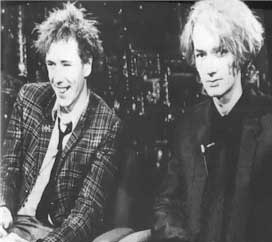
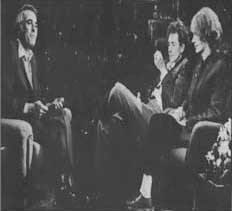
While they seem tame by today's standards, many people can still remember such events on television in the '70s. A good example is when an intoxicated Truman Capote was interviewed on the Stanley Siegal Show. Perhaps these past events were memorable because we knew they were for real. They lacked the artificial nature of today's talk shows, which seem more kin to professional wrestling - leaving the viewer to wonder just how much has been staged or pre-planned for their benefit. Another such "real-life" example of a talk show confrontation occurred on June 27, 1980, when Tom Snyder interviewed John Lydon and Keith Levene on his Tomorrow program for NBC.
 Even
before this interview aired, many people were expecting a great confrontation.
John Lydon, also known as Johnny Rotten, was the lead singer of The
Sex Pistols, arguably the leaders of the punk rock movement. Virtually
every interview John gave became a confrontation. John seemed to delight
in insulting people in his interviews, and often that included the interviewer
as well. In 1976, the band was in the midst of a nationwide scandal
when they appeared on The Today Show with Bill Grundy and let
out a few choice swear words during the live program. They were soon
dropped from their record company, EMI, and Bill Grundy was suspended
and later fired for encouraging the band members to continue their cursing
on the air. When The Sex Pistols eventually broke-up in 1978,
John formed Public Image Limited with Keith Levene, a friend
of his who reportedly was kicked-out of fellow punk band The Clash
for his dependence on heroin. The scheduling of John on the Tomorrow
program seemed as if it was planned to be a carbon copy of the Bill
Grundy incident. Apart from the similarities in the program titles,
Tom Snyder seemed like the perfect match for John Lydon, in that he
was known for employing tough interviewing tactics when needed, and
for his notoriety not to back down from a confrontation.
Even
before this interview aired, many people were expecting a great confrontation.
John Lydon, also known as Johnny Rotten, was the lead singer of The
Sex Pistols, arguably the leaders of the punk rock movement. Virtually
every interview John gave became a confrontation. John seemed to delight
in insulting people in his interviews, and often that included the interviewer
as well. In 1976, the band was in the midst of a nationwide scandal
when they appeared on The Today Show with Bill Grundy and let
out a few choice swear words during the live program. They were soon
dropped from their record company, EMI, and Bill Grundy was suspended
and later fired for encouraging the band members to continue their cursing
on the air. When The Sex Pistols eventually broke-up in 1978,
John formed Public Image Limited with Keith Levene, a friend
of his who reportedly was kicked-out of fellow punk band The Clash
for his dependence on heroin. The scheduling of John on the Tomorrow
program seemed as if it was planned to be a carbon copy of the Bill
Grundy incident. Apart from the similarities in the program titles,
Tom Snyder seemed like the perfect match for John Lydon, in that he
was known for employing tough interviewing tactics when needed, and
for his notoriety not to back down from a confrontation.
The following is my interpretation of that interview. While the words and actions depicted are real, I have added emotions and thoughts which I believe to have existed in the minds of the participants at the time. Therefore, the following is more of a novelization of the interview, rather than a straightforward transcript. I hope this makes the paper more interesting and readable.
Coming back from a commercial break, the interview begins with Tom Snyder's introduction, "Now joining me are Mr. John Lydon, who used to be know as Johnny Rotten, and Mr. Keith Levene." The audience sees John, who is slumped in his chair, looking extremely bored and somewhat mentally absent, and Keith, who is sitting up straight in his chair, looking very attentive. As we will discover, the opposite is true: it is John who is attentive while Keith seems to be on a drug-induced mental vacation. Tom continues, "And they are both associated now in something which is called Public Image Limited." Tom read the name of the band very slowly.
"Limited," Keith adds, fearing Tom forgot the band's name. Instead of clearing things up, he ends up confusing the host.
"Is it limited or unlimited?" Tom asks.
"It's limited," Keith answers in a deadpan demeanor.
Tom continues, "Limited. What is that? Is a band? Is it a public relations firm? What does it do and what is it?"
John straightens up. Still looking bored and wanting to get the interview over with, he announces, "We ain't no band, we're a company. Simple. Nothing to do with rock 'n' roll." There is no response from Tom, so John adds, "Doo dah."
Tom picks up on that. "Doo dah," he repeats. "Okay, it's a company, not a band - simple. What kind of a company is it? What does it do?"
John starts to answer with, "It's just a . . ." but is cut off by Keith's answer.
"It's a communications company."
"Huh?" Tom asks.
Keith repeats, "It's a communications company."
Tom is left to ask, "To facilitate communications how?"
John lets out a sigh as if he were a schoolboy who was just informed a pop quiz is eminent. He answers, "Videos, movies, sound-tracks for films," Both John and Keith turn to the camera as if talking to a single, particular viewer as John adds the words, "we hope, soon!" They turn their gaze back to Tom. "Sometimes we perform live gigs, and that depends on how we feel. Just about anything that's available."
With the serious and dedicated expression of a man asking God the meaning of life, Tom asks, "When you perform a live gig, do you bring musical instruments to it?"
With the vacant and confused expression of a man trying to comprehend the meaning of life, Keith answers plainly, "Yes."
John adds a little color by adding, "So far."
Tom springs into action, believing he has a major point, "Well, but you said it's not a band."
"It's a company," Lydon confirms.
Tom seems unhappy with the response. Again, he repeats the last word spoken. "Company. Would you rather not . . ."
John interrupts. "Companies can mess about with musical instruments. There's no limits."
This still does not satisfy Tom. "Would you rather not talk about the company?"
While John laughs, Keith answers, "No, I like to talk about it."
"I beg your pardon?" Tom begs.
Finally awake, John sarcastically points out, "This is why we are here!"
John and Keith laugh to themselves as Tom tries to save face to the camera. "Well, I want you to talk about it, and I've made five passes at it, and so far I'm not getting anywhere, and I . . ."
John interrupts. He is finally awake and up to his old, sarcastic interviewing standards. "Well, surely you've studied your history of us. I mean, come on - prompt!" he says. Tom seems at a loss for words, perhaps pretending to be shocked by this response. "Do your business," John adds.
As if apologizing, Keith offers, "We're jet-lagged."
"Humor us," John orders.
Tom, again, tries to save face with his audience. "Well, ah, I've asked you what kind of a company it is, and you've said it's a company that deals in communications . . ."
He is interrupted by John, who tries to clear things up a bit. Looking downwards and picking at his fingernails, John states, "Well, it's simple - right. We do anything that we're offered if it's worthwhile. So, like, at the moment, me and Keith want to dabble with film sound-tracks."
There is a pause. We see a close-up on Tom. He is expecting John to say more. We see a close-up of John from over Tom's shoulder. He looks up at Tom, notices he expects more and gives him a smile, indicating that his explanation is over. The same sort of smile a puppy gives when he's just been house-trained and has made his first successful poop in the yard. Again, Tom is left to repeat the last words said. "Dabble with film sound-tracks." John nods his smiling head, mocking the host and displaying his ghastly green teeth which would make any sane dentist shudder. "What does that mean? I don't know what that is," Tom inquires.
 While
John shakes his head and goes for his cup of water, Keith starts talking.
The audience is in trouble now, for, as I mentioned earlier, Keith seems
to be on another planet. Perhaps he is, indeed, simply jet-lagged as
he had mentioned. Whatever the cause, keep in mind that each pause indicated
during Keith's speech is of considerable length, especially given the
fact that, as a television show, there is a serious need to keep viewers
from switching the channel. "Well, [pause] we started off [pause]
with Public Image Limited, [pause] we didn't want to be, or have anything
to do with rock 'n' roll. [pause] So [pause] we thought being in a band
and doing gigs [pause] wouldn't be the thing to do."
While
John shakes his head and goes for his cup of water, Keith starts talking.
The audience is in trouble now, for, as I mentioned earlier, Keith seems
to be on another planet. Perhaps he is, indeed, simply jet-lagged as
he had mentioned. Whatever the cause, keep in mind that each pause indicated
during Keith's speech is of considerable length, especially given the
fact that, as a television show, there is a serious need to keep viewers
from switching the channel. "Well, [pause] we started off [pause]
with Public Image Limited, [pause] we didn't want to be, or have anything
to do with rock 'n' roll. [pause] So [pause] we thought being in a band
and doing gigs [pause] wouldn't be the thing to do."
Even when he isn't pausing, Keith's speech is slow and deliberate. Tom, seeming to realize that he's in for a long stretch, reaches for a cigarette. His actions do not go unnoticed by John, who asks, politely, "I'll have a cig."
"Would you like a cig?" Tom happily questions, feeling a possible bonding experience about to take place.
Keith goes on, unconcerned that the focus has been diverted from his speech. "We ended up doing an American tour."
Tom cheerfully hands a cigarette to John while announcing, "I'll find a way to your hearts, yet, though - I'll tell ya!" He suddenly realizes he has interrupted Keith's painfully slow answer to a question asked long ago and already forgotten by most. "Excuse me, sir," he tells him.
Unfortunately, Keith does go on. "We ended up doing an American tour, which, umm [pause] definitely prompted us to stop [pause] the band side of it, and concentrate on the company side of things."
Tom takes the opportunity to cut in during a long pause to ask, "Both you and John have said that you don't want this to have anything to do with rock 'n' roll. Why do you dislike rock 'n' roll so much?"
John seems happy to answer. "It's dead. It's a disease. It's a plague. It's been going on for too long. It's history. It's vile. It's not achieving anything, it's just regression. They play rock 'n' roll at airports. It's about as like advanced as it can possibly get!"
Tom tries to ask, "But there was a . . ."
John interrupts. He is not finished with his answer. "It's too limited."
Tom tries again to ask his question. "But there was a time when you didn't feel that way!"
John is still not finished giving his answer. His head bobs back and forth like a cobra about to strike. "It is too much like a structure, a church."
Once more, Tom tries to interject. "Yeah, but there was . . ."
"A religion. A farce," John adds.
Tom forcefully reiterates the main part of his question. "A time when you did not feel that way! What made you change your mind?"
Given the opportunity now to think about the question, John answers, "No, I've always felt this way."
Tom brings up a sore subject. "Even when you were with the Sex Pistols?" The Sex Pistols was a subject John seemed to want to forget, possibly due to the turmoil in their final days which resulted in the band's breakup amid rumors of John's being fired from the band.
"I wondered when you'd get round to that one!" John announces like a child who has been given the same parental lecture time and time again. "Yes, even then! Because the Sex Pistols was going to be the absolute end of rock 'n' roll, which I thought it was. Unfortunately, the majority of the public, being the senile animals that they are, got that wrong. Too bad. All's I want is an image - something flash."
Tom, perhaps not realizing that John and Keith are there to talk about their current band, asks, "Where did the name The Sex Pistols come from? Who thought that name up?"
John sighs before saying, "Some animal, I can't remember. It doesn't matter. It's history."
"Well, I think history matters a little bit!" Tom says, not wanting to let go of the question. "When you say 'some animal,' was this a member of the band that made it . . ."
"History does not matter." John interrupts with a sigh. Tom gives him a look that could kill. John adds, "I mean your program's called Tomorrow - there must be a reason behind that!
Tom lightens up. He is now able to deliver a line which it would seem was thought up years ago, but has never had the opportunity to be used before now: "Well, unless we remember our yesterdays, there will be no tomorrows."
John seemed to have liked that response, and mumbles something in a singsong voice to Keith. I imagine it was something along the lines of "what a clever moron Tom is," but, unfortunately, John mumbled the line so thoroughly as to make it completely unintelligible. Keith interjects. "Getting back to Public Image."
Tom is caught off guard. Keith has been nice to him so far, so he does not know how to respond. "I beg your pardon?" he asks.
"Getting back to Pil."
"Oh, to Public Image."
Here we go with another long, rambling speech by Keith Levene. "Yeah, we were saying we learned from our yesterdays, and our recent American tour, [pause] that it was embarrassing to go on stage and do gigs. Cause, um, it's [pause] it seems to be an old-fashioned format to go on stage with guitars and [pause] play loud music. I mean, I'm definitely into loud, annoying music, but, um [long pause] like, um, getting back to the communications side of things. The people that we are communicating to . . ."
John can not take it anymore. He tries to cut in. "Instead of, like . . ."
Keith is oblivious, and continues. " . . .is just the wrong people."
John successfully interrupts Keith. "A concept these days is a bunch of ghits on a stage with all these idiots down in the pits, worshiping them - thinking they're heroes. There should be no difference between who's on stage and who's in the audience. And we've tried very hard to break down those barriers, but it's not working! So we have to think again So in the meantime, we'll put our attentions somewhere else." He says this last line like a psychopath who won't reveal the hiding place of a bomb he hid in the local schoolhouse.
Tom seems unsure of where he stands. He thought he bonded by giving John a cigarette earlier, but now it seems they are on opposing sides again. "Can I ask you what you did to try to break down the barriers between the people on stage and in the audience? Some of the things?"
John starts to answer, but Keith gets there first. Fortunately, and quite uncharacteristically, he utters a few complete sentences without pausing once. "We were totally honest with them! We went on stage and we were totally honest. We weren't - we weren't saying, 'Look at me! I'm great! I'm a superstar!' And we weren't saying particularly anything. We were going on there and playing our music. And anything could have happened when we went on stage."
"And it did!" John adds.
"And it did happen!" Keith continues. "But we were totally honest with our audience." This would have been a perfect time for Keith to stop, but it seems his neurons were not firing successfully enough to convey that suggestion to his consciousness. "And the reactions we got [pause] which, uh [pause] we got about four years ago in England, or the Sex Pistols got, and various other punk bands [pause] were the reactions we got in America."
John interrupts. "That's the trouble with America, it is so regressive!" He gives us a mocking laugh. "So backwards!"
Keith seemed to forget what he was saying, which was just as well--most of the audience probably forgot what he was saying also. He reacts to John's remark. "John said something in an interview, everyone's really preoccupied with going backwards; and I think [pause] the reason [pause] that it's a good idea not to be a rock 'n' roll band, and to concentrate or direct our energies as a company is because . . ."
There is now a long pause while everyone is waiting for Keith to finish his thought. The sound of people switching channels all across the nation could be heard. All at once, John and Tom start talking, trying to make important points. Unfortunately for us, since both of them were trying to out-shout the other, neither person's statement could be understood. At the end of this period, Tom says, "Excuse me for talking while you were interrupting. I have to do a couple of commercials here. We'll continue, ah . . ."
John laughs and spits out the command, "Humor me!"
"Not for long," Tom promises John. He then finishes his sentence to the camera, "with this fascinating discussion right after these announcements. Isn't this fun, gang?"
We return from a long commercial break to find Tom smiling. John and Keith look like two schoolboys who have just been scolded by the teacher. Tom says cheerfully, "Back now with John and Keith who are with Public Image Limited. You know, it's been so long that I've almost forgotten where we were when we were at it!"
Like a cobra spitting venom, John recounts, "Uh, you went into a bit of a tantrum as I likely remember."
"Oh, yes I did," Tom says, sarcastic and angry once again. He sounds as if he wants to end the interview right then and there.
John, perhaps sensing this, starts to talk. "You want to hear about us. Right. We have record commitments with Warner Brothers in America and Virgin for the rest of the world. We will, of course, oblige them; but, in the meantime, there is the possibility of us doing a sound-track to a film in Hollywood. This interests us greatly."
Tom, lulled into a false sense of security by the sudden openness of John, has a change of mood, and starts to ask a question. "What are . . ."
But he is interrupted once more by John, who adds, "We are not a band, we are a company. We have many interests. We are also making our own film in England right now at this very moment."
Hesitantly, Tom asks, "The music that you will do for the record companies that you mentioned. How will this music differ from what we thought was rock 'n' roll?"
John lets out yet another sigh. "It's no more of that twelve-bar ditty, waving hair in the breeze, platform boots, flap your flair nonsense. It's not a packaged image of third-rate idiots. It's not a pose. We just do our stuff, hated as it usually is. I was very shocked by the reviews of the last album. I believe none of them. I think they liked us for the wrong reasons."
Tom foolishly tries to ask another question. "Well you told me all the things . . ."
But John is not ready to hear a new question, and continues with his previous answer. "Trendy reasons." Then, suddenly, and with the politeness of brainless hostess at Disneyland, John asks, "Can I have a cigarette again, please?"
Tom is totally caught off guard. "Ah, yeah, if you'll just . . ."
John smiles and points casually toward the box of nicotine sticks. "This won't cause an argument now?"
Tom reaches for the box. "No, of course not, but you told me all the things that your music is not, but you didn't tell me what it is!" he says, opening the box and offering it to John.
"I don't know what it is." John says, picking out a cigarette from the box.
Tom is angry once again. "Oh, well that's probably the reason why you didn't." he says in an indignant, sarcastic tone as he slams the box closed and tosses it on the table behind him.
John leaves his seat and heads towards Tom while explaining, "It doesn't matter. It doesn't need a title anymore!"
Tom is surprised by John's sudden advance. Was he going to hit him? Were all these stories true about the violent nature of punk rockers? Tom has a worried look on his face, which goes away when he realizes John is only reaching for the lighter which is on the table behind his chair. "Okay," he replies, in a tone of voice which clearly says "enough is enough." He is angry over the lack of progress the interview has taken. He is angry over the uncooperative attitude of his guests, and the nerve of John daring to leave his seat during the interview and hover over him like he just did. That just pushed Tom over the edge. This was the turning point of this
"war"--Tom needed a tactical advantage.
John continues to reply as he lights his cigarette. "It doesn't need a bracket, a category or any of those things."
"Right," Tom confirms.
John closes his response with, "As I have said, it is not the Church."
We see just how angered Tom is when he mocks John by reaffirming his earlier statements. "Not a band - a company. Right. Not a performance - a gig." That bit of venting puts a smile back on Tom's face. Not a happy one, but a sort of vengeful smile. "Well, let's go to some questions for John and Keith from our viewers. Can I ask you a question sent in by one of the viewers?"
John sighs. "It's bound to be awful, come on."
Tom addresses John's concern. "No, as a matter of fact, it's, uh, I think you'll find it's an interesting question. I hope you'll find it's an interesting question."
"All right," John says.
Tom now talks to John as if he were a child. "If it isn't, we'll throw the question away. Is that okay?"
John laughs at his sudden change in attitude, but, suddenly realizing he is being made fun of, his expression turns to a "fed-up" look. "Go on," he orders.
Tom is still smiling. In his mind, he just scored a mark in this verbal battle. He reads the letter. "Okay. Could you please ask John the following question when he's on your show. Regarding a song on the Second Edition album, what is The Chant? It's been driving us crazy. This is signed by some viewers in Indianapolis, Indiana. There's the question right there. What is the chant? It's driving us crazy."
John looks a bit perplexed, and no wonder--The Chant is the title of one of their songs. This is not a clear question. Are they asking what the chorus of the song is? There is a chant-like phrase in the piece which repeats, "Love, war, kill, hate" over and over. Is this what the viewer is asking? There is a short pause before John laughs at the ridiculous nature of the letter and asks Keith, "Well, Keith, what's the chant?"
Eager for a second opportunity to score points in the battle, Tom turns immediately to the camera and happily shouts out to America, "Well, gang, out there in Indianapolis, there's your answer! You've been going crazy for it now for months, and you got the answer! That's fantastic! What an answer!"
"It's a ditty!" John shouts, showing us that Tom's remarks got to him. He calms down quickly. "Simple as that. Hate it or love it."
Finally, the interview seems to get on track when Tom asks, "You really don't care what your audiences thinks of you, do you?"
John now seems honest in his response. Perhaps they are both tired of playing to the audience. Unfortunately, the interview is almost over, and it's a bit too late to salvage anything from the wreck. "No. It doesn't matter. It's irrelevant," John answers.
Suddenly, we are in a normal interview. Treating John as if he were a post-Watergate Nixon, Tom asks, "What is relevant?"
John sighs--not a good sign. "Just us getting on with what we want to do. If people appreciate it, that's fine; but we're certainly not going to condescend. Too bad if that makes us look like snot-nosed little ghits; but that's probably what we are. At least we're doing it. This ain't no armchair outfit. I mean, you seem confused by the fact that . . ."
Tom interrupts, "I'm very confused, John - I'll tell you."
John carries on, taking no notice of Tom, "we don't want to be a band - we are a company."
Tom tries interrupting more forcefully, "No, no - John, let me tell ya . . ."
John isn't about to let Tom get a word in edgewise until he is good and ready. "But I mean, you look at any business - how many interests do they have? You take EMI Records." John gives a sarcastic laugh as he mentions the name of the record label that dropped The Sex Pistols soon after the Grundy interview. "You look at what they're connected to. You can drag them into Golden Egg restaurants, even supplying arms to South Africa! I mean the list is long."
Keith springs to life--as much as he can, which isn't much--by announcing, "We're into positive interests."
Tom is probably looking at the clock and sighing at the fact that he still has a few minutes to fill before the program ends. "Let me try this," he states. "What do you like? I mean, I've heard you tell about a lot of things you don't like; what do you like?"
Keith seems confused. "In terms of what?"
"In terms of 'The World.'" Tom answers, nastily. "In terms of . . ."
John cuts in, "Not very much!"
Tired of John, but too quickly forgetting the state of his other guest, Tom points to Keith and asks, "Ah, well, could he answer it, then?"
"But that's not my fault!" John adds before turning the floor over to his band-mate.
Slowly, Keith answers, "No, I don't think I could. Not offhand. Not without having to think about it [pause] for a long time." There is a long pause now as Keith thinks. The air has been sucked out of the studio. The dialogue between Tom and John has been quick and on target, but Keith talks like an author with writer's block. "Um, what do I like?" he continues.
John can't take it anymore, and jumps in. "Being allowed to get on with it without record company hassles. They seem as confused as you do about us. That's just unfortunate."
Tom sighs. He is ready to sign off. "Well, it is unfortunate that, uh . . ."
John again interrupts. "See, we're not very intellectual, we just do it."
Meanwhile, Keith has come up with something he'd like to share with us. "I know! I only know what I don't like." he discloses.
Tom doesn't know whether Keith is putting him on, or is really out of it. Dumfounded, he repeats "You only know what you don't like."
"Yeah," Keith replies, "but I'm a very easygoing chap."
Tom smiles, uncontrollably, lost between the rudeness of John and the insipid idiocy of Keith. His smile quickly fades as John opens his mouth and announces, "We're looking for that shining star, somewhere up there!"
Tom watches as John starts laughing uncontrollably. John seems to be acting more like Keith now. Tom starts to give his final statement. "Well, it's unfortunate that we are all . . ."
John interrupts by singing the line, "Somewhere over the rainbow!"
Tom smiles, and while John sips his water, he takes advantage of the opportunity by trying to deliver his closing statement once again. "It's unfortunate that we are all out of step except for you. I wish that something could be done."
John almost chokes while drinking--he's been looking for an open opportunity such as this. "This is what I've been telling the world for about five, six years now!" he declares. "I wish you'd all grow up!"
Tom no longer tries to disguise his disgust with Lydon. "Well, I hope we do," he cynically responds.
Sensing the interview is almost up, John takes a last grasp at irritating his host. "Oh, it was great watching Carter, and his boat, not being able to land in Venice," he tells, his mocking smile outlining his disgustingly green teeth. "Oh, I was impressed!"
Uncharacteristically, Keith spouts out a good line. "Yeah, that's something John liked!"
As John and Keith laugh, a disgusted Tom really tries to end the interview. "John and Keith, it's been really interesting . . ."
John interrupts. "I liked watching Carter fall down . . ."
Tom tries to talk over him. "Interesting having you on tonight."
But John just continues in a louder voice. " . . .the steps of his plane!"
Tom repeats himself. "Interesting having you on tonight. One of the most interesting moments in my life."
Keith gives Tom his first insult of the night. "I'm sure it could be."
"Well, as I say, it's unfortunate that we're all out of step except you," Tom repeats. "Too bad."
Tom turns away from them as John offers his last bit of advice. "We'll be your shoes!"
Trying to ignore them, Tom states, "Yeah, maybe that. We'll continue after these announcements from the NBC television stations. Come back." After this last commercial break, Tom returns to sum up the interview. He speaks to the camera. "Now for those people that would like a full transcript of tonight's show, with, ah, with footnotes, you send ten cents to me and I will try to return the transcript to you. I don't understand that, but they'll probably make a million dollars with it - and that's, that's showbiz. What a night, huh? The interesting part is, is that we talked to these two gentlemen a couple of weeks ago, a pre-interview, apparently that went all just fine and it made great sense, and what I read about them this afternoon, but somehow it got a little lost in translation tonight. But that's probably my fault."
"Probably my fault." I guess that is accurate, but I am convinced that everyone involved knew what they were in for when they booked John Lydon and company on the show. The only thing they may have been regretful over was the fact that Lydon did not swear during the program, or do anything that would have made the news shows and given the show a little free publicity.
A few months ago, John Lydon and former band-mates Glen Matlock, Steve Jones and Paul Cook announced a reunion tour of The Sex Pistols. The press conference, held in England, proved that John had not settled down in the last sixteen years, at least in terms of his interviewing manners. One thing that I found impressive, however, was that John admitted the reunion tour was a way to earn some money. Charged with hypocrisy from members of the press, John calmly said that he was not being hypocritical, but he had simply had a change of mind. Years before, he had stated that he had not done anything specifically to make money. With the tour due to start in Finland on June 21, there is no doubt that Lydon will be on the interview circuit once again. Of course, Tom Snyder is back on the air again, following Letterman on CBS. Could we see a rematch? Stay tuned.
Works Cited:
Tomorrow. NBC. KNBC, Los Angeles. 26 June 1980

John & Keith, Tomorrow Show 26th June 1980 © unknown
Tom Snyder, John & Keith, Tomorrow Show 26th June 1980 © unknown